Monday, 6 April 2020

Confinement birding part 2


I've not discovered any more lifers during the past week although an immature Marsh Harrier, which migrated northwards early on 1 April, became the 65th species I've seen or heard from my apartment since I moved in 4.5 years ago.  Other than that, it has been very quiet birdwise and I only managed one short birdwalk in the Bois de la Cambre, which is about ten minutes away.  I did find the avian equivalent of a high-rise apartment building though, as one large, dead tree seemed to house one or two pairs of Jackdaw as well as nesting Stock Dove and Middle Spotted Woodpecker!  My nesting Great Tits seem to have decided they have gathered enough moss and are now bringing feathers instead, whilst the local Woodpigeons are going crazy for the buds of one tree.  I regularly counted up to a dozen of them at once and this particular individual has taken a liking to sitting on my windowledge, presumably as it was warm being just the other side of the wall from my radiator.

Monday, 30 March 2020

Confinement birding part 1


Well, that didn't take long!  I wrote last Tuesday that I was looking forward to seeing my first Swallow of the year and, on Saturday morning, one winged its way past during a great session of birding from my apartment during which I saw or heard 22 different species.  The above Grey Heron was one of two which also migrated over, as did three Redwings.  The biggest surprise of the morning, however, was a lovely male Black Redstart, which is a new addition to my apartment list.  A pair of Great Tits seem to be nesting on the corner of my building and return every five minutes with a new beakful of moss.


I'm amazed at the amount of moss they've brought over the past few days and wonder where they are depositing it all.  Great Tit was also the subject of a nice discovery when I decided to go through my notebook from my 2002 trip to Australia.  This was mainly to help pass the time and relive the experience, now that any form of travelling seems unthinkable for the foreseeable future, but also to make sure I'd recorded all relevant subspecies with a view to potential splits.  I soon found out that the Great Tits I saw during my stopover in Hong Kong have since been split as Japanese Tit.  Here again is one of my local birds with, for comparison, a stamp from North Korea showing the considerably less colourful Japanese form.


I then discovered that the Australian forms of what I'd recorded as Black-winged Stilt, Clamorous Reed Warbler and Richard's Pipit have also been split, resulting in a total of four new species for my life-list.  Who would have thought I'd be adding new birds during this period of confinement!

Tuesday, 24 March 2020

Full stop!


It's OK, my punctuation hasn't gone awry.  I'm well aware this, my first butterfly of the year seen during a walk in the forest today, is a Comma.  It's just that a comma would indicate there is more to come, whereas today felt much more like a full stop.  The confinement measures currently in place in Belgium mean that we are only allowed to go out for local walks or exercise.  The Sonian Forest is the only birdy place within reasonable walking distance of my apartment but, as with my regular patch just over a week ago, it was full of noisy kids, dogs running all over the place and far too many people to really enjoy.  Despite all this, I still managed to find three different Middle Spotted Woodpeckers, one of which looked like she may have been excavating a nesthole, a Firecrest, some Hawfinches, and got to watch a Kingfisher doing a strange display flight high up amongst the trees.  Not too bad, considering, but the birch pollen season has just begun so the forest is the worst place for me to be for the next month or so.  It thus looks like my birding for the foreseeable future will be restricted to watching for migrants from my balcony.  The past few days I've had groups of two and four Cormorants go over, as well as single Buzzard and Sparrowhawk, and I'm really looking forward to seeing my first Swallow of the year.  Little things, but we have to make do with what we can at the moment and simply hope that we'll once again be able to visit the coast for the breeding waders or do a long hike in the Ardennes.

Wednesday, 18 March 2020

Crazy, crazy times


These are strange, disconcerting times for everyone but, meanwhile, the natural world is going about its business regardless.  I finally heard my first Chiffchaffs in the Sonian Forest on 7 March, about ten days later than last year, which is strange considering how mild it has been.  Two days later, the first had reached my local park; it usually takes them a few days extra to penetrate into the city.  This Alexandrine Parakeet, taken through the bars of my balcony to avoid scaring it off, was checking out the activity at my peanut feeder.  Despite their bigger size and heavier bill, they are extremely wary and much more discrete than their boisterous cousins, the Ring-necked Parakeet, and this one didn't dare to come any closer to feed.  Last Saturday, I made a brief visit to my Brussels patch, where my old friend, the female Ferruginous Duck, now approaching the end of her 8th winter in Brussels, was busy sleeping.  It was extremely busy, however, almost like a bank holiday, since everything else is closed and the only thing people have left to do is take a walk in the park.  Stay safe, everyone!

Tuesday, 3 March 2020

City birding


Over the weekend, I was in Berlin for a city trip.  Originally, I wasn't planning to do any birding but, once I heard about a suburban lake with resident Red-necked Grebes, I couldn't resist taking my binoculars along since I very rarely get to see this species in breeding plumage.  Sure enough, as soon as I arrived at the Schäfersee, right next to a U-Bahn station, I could hear some very loud calls, a bit like a Water Rail with a megaphone, echoing around the circular lake as the three pairs proclaimed their territories.  I realised I'd never actually heard Red-necked Grebes displaying before, with a pair of displaying Kingfishers as an added, unexpected bonus in this urban setting.  I also tried another city park where some Waxwings had been reported but only managed to find Redwings, my first Fieldfare of the year, and a pair of Hawfinches.  On the second day, I visited Treptower Park along the River Spree, mainly with the intention of seeing Goosander, another species I'd not connected with so far this year.  I found a pair straight away but the woodland provided a wonderful surprise when I located this female Black Woodpecker excavating a nesthole.  I'd first heard the distinctive call and headed towards the source, only for the sound to repeat itself much closer.  Frantically looking around at all the likely trees, I just couldn't locate the bird until I noticed wood chippings raining down on me and realised she was right above me!


The male also came in after a while, as if to inspect her work.


Locating a Black Woodpecker nesthole is a birder's Holy Grail and I've never been able to find one in Brussels.  Overall, though, I was very impressed with just how birdy Berlin is, with a seemingly healthy House Sparrow population and plenty of both Greenfinches and Goldfinches, even in the built-up areas.

Tuesday, 25 February 2020

Wet and windy


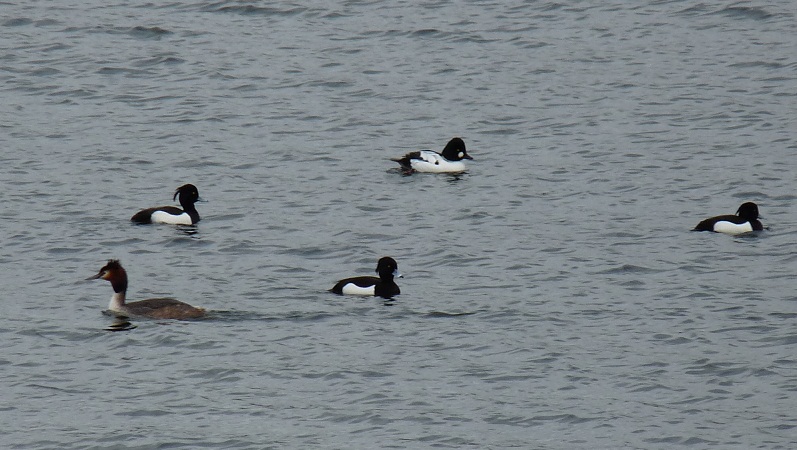
Pretty much the whole of February has been wet and very windy, which explains the lack of recent updates.  Since my last post, I've only been out birding three times; a short walk in the forest, adding Middle Spotted Woodpecker to my year list, a visit to my Brussels patch, and, last week, a trip to a lake in West Flanders which usually has Bittern.  The Bittern failed to show but this male Goldeneye was hanging out with his Tufted friends and I actually got to see a Cetti's Warbler which I usually have to be content with only hearing.  That was my 110th species of the year and it shouldn't be long now until the first Chiffchaffs arrive, getting spring migration underway.  Despite the first sunny morning in weeks, there was no sign of any in my local park this morning.

Monday, 3 February 2020

Wet, wet, wet


Yesterday, it was time for my annual wild goose chase around Zeeland but, despite the very wet and windy weather, I did not end up wishing I was lucky!  We had decided the conditions only really allowed for birding from the car so our first stop was this rather bedraggled female Great Bustard from the German release project.  Hatched in an incubator last May, she was then released into the dwindling bustard population in the state of Brandenburg, only to disappear around 10 November.  She was subsequently found in the delta south of Rotterdam on 28 December and has remained faithful to the same field ever since, making for a very easy twitch.  She did not seem to be enjoying the rain at all although she did perk up after a while and start feeding, and her field was also home to several Mute Swans so there must be plenty of food there.  Having driven right up to our main target of the day, we still had plenty of time left and thus decided to move to another area where 5 Whooper Swans and 50 Tundra Bean Geese had been reported.  On the way there, though, we discovered our own flock of at least 450 Tundra Bean Geese (!) and passed flock upon flock of Barnacle Geese.  By the time we eventually reached our second destination, we must have seen well over 6000 Barnacles at the very least and, sure enough, I immediately spotted 5 large, white blobs in the distance which turned out to be the Whoopers.


As you may have noticed, the two geese on the right were part of the original 50 Tundra Bean Geese we were hoping to find but, by now, our tally of this species was close to 600 birds.


We then turned our attention to some other species, finding good numbers of Pintail, Goldeneye, Red-breasted Merganser and Golden Plover, as well as around 20 Bar-tailed Godwits, which must have stayed for the winter.  The geese still had one final surprise up their sleeve, however, as we then found a couple of small flocks of Brent Geese to end a very succesful wild goose chase, and we didn't even get wet!