Earlier this week, I then went and saw another Hume's Warbler in a park in Ghent, where it seems to be overwintering. Amazingly, though, birders looking for the Hume's Warbler also discovered a Pallas's Warbler, which seems to be overwintering in the same city park. It took me a long time to see anything, the first bird I found being a very vocal, female Firecrest, but I then heard the distant calls of the Hume's Warbler and managed to locate it. It was very mobile so I followed it to another section of the park, where a small group of birders were already watching the spritely Pallas's Warbler. This was only my third observation of this species and my first in Belgium, and it put on a great show, at times hovering so close to me I couldn't even use my binoculars. As I was enjoying that, a Goldcrest also appeared and, although I know the 'crests are no longer officially considered as warblers, I still think of them as such, thus making it a 4-warbler day in Belgian city park in late December!
Showing posts with label Eilat. Show all posts
Showing posts with label Eilat. Show all posts
Friday, 30 December 2022
Winter warbler wonderland
The rest of my week in Eilat was much less productive, partly since I was exhausted from my long hike through the desert, but also because I spent a lot of time trying in vain to spot the Swinhoe's Storm-Petrels, which had been frequenting the Gulf of Eilat, from shore. I thus ended the trip with zero lifers and just three new additions to my Israeli list; the Wigeon, a Great Crested Grebe on the sea off North Beach, and my 4th ever Hume's Warbler twitched in a city park.

Tuesday, 27 December 2022
Frosted raspberries
For my second day in Eilat, I got a taxi to drop me off at the entrance road to Amram's Pillars, another site I'd never managed to reach before. Having seen no wheatears whatsoever the previous day, my first birds were Hooded and Mourning Wheatears, with several singing White-crowned Black Wheatears later on. I took a good couple of hours to reach the campground, where some other birders who were on their way out had told me they'd seen my target species. Once there, though, all I found was a large group of Trumpeter Finches, so I continued further along the road to the junction with the next hiking trail. Here, I started to hear faint calls coming from the cliffs and began scanning. Suddenly, I found a big, fat, frosted raspberry of a male Sinai Rosefinch just sitting there on the cliff-face. I then noticed some females/immatures hiding in the crevices and eventually had five of them come down and feed.


This was my most wanted bird of the trip since I'd only ever had a brief, distant glimpse of a small group way back in 2009, so I was relieved to finally remove the unwanted bvd-label from this species. After that, it was time for the long slog back through the desert to the nearest bus-stop, although I did break it up by having a look at the km20 saltpans, where three male Wigeon were a bit of a surprise since I didn't realise they migrate all the way down into Africa.
Sunday, 25 December 2022
Eilat again
I flew back to Eilat earlier this month for a week of winter sun and birding which got off to a great start when I finally managed to visit Holland Park, on the outskirts of the city. Some of the first birds I saw were Arabian Green Bee-Eaters, which are fairly common but always such a joy to behold.


I had intended on just having a quick look around before heading down to the IBRCE reserve but the park was much bigger than I expected and I ended up spending all morning there. Having already flushed one Sand Partridge, I fully expected the next three birds I flushed to be the same but, thankfully, one of them landed under a bush just a little further along the trail and I couldn't believe my eyes.

My first Liechtenstein's Sandgrouse since 2003 sitting there in the middle of the day! I admired it for the longest time just blending in with the vegetation and being ever so difficult to locate with my camera, the yellow, black and white eye markings being the only give-away. I felt guilty walking away from such a rare opportunity and even turned round and walked a different route so as not to disturb it again. This resulted in me discovering a bush which was full of African Babul Blues, not the prettiest of blues but a real challenge to photograph since they are so tiny.

Having also seen a lone Arabian Babbler, a small flock of Indian Silverbills and another group of five Liechtenstein's Sandgrouse in flight, I eventually made my way to IBRCE, where Bittern, Spotted Eagle, 3 Steppe Eagles, a hunting Black-winged Kite and an Oriental Honey-Buzzard rounded off an excellent first day with a total of 61 species.
Friday, 6 December 2019
Eilat day 5

I just had a few hours on my final morning before heading back to the airport for my early afternoon flight. After the exertions of the previous day, it was hard to motivate myself to do anything since I didn't really expect to find any new birds. There had been a very strong southerly wind the previous evening, however, which was whipping the sea into a frenzy more typical of Ostend than Eilat, so I visited North Beach once again, where this Striated Heron was calmly hunting its way along the row of buoys. On the way there, 3 Common Mynah were feeding in Ofira Park, another species I'd not seen the previous days and which seems to have colonised the whole of Israel since my last visit, when it was only found in the north of the country. An immature Armenian Gull was the third new species of the morning, thus taking my short holiday list to 77 species in 4 days. I was also pleased to spot this lionfish loafing around the rocks within the harbour, before returning to the airport and the grey skies of Belgium.

Wednesday, 4 December 2019
Eilat day 4
Spurred on by my success of the previous day, I took the early (06h30) bus to Uvda valley, an extremely remote and extensive wadi which potentially held at least five more lifers for me. Before arriving in Eilat, I had no idea this area could even be reached by public transport but Noam's excellent directions convinced me to give it a go, especially since I was told there were lots of Temminck's Larks around. I was thus hopeful of finding at least one new species but, once there, the plain seemed totally devoid of life, as is often the case in the desert. The first bird I saw was a Hoopoe Lark, a highly sought-after species I'd only seen once before, although it took me quite a while to work out what it was in the early morning light. I then found a swath of green stretching across the valley which was alive with wagtails, Stonechats, Desert Larks and Mourning Wheatears. Here, I spotted a small, black wheatear perched atop a bush and immediately noticed a more compact profile, more rounded head and shorter bill compared to the more elongated, almost Blue Rock Thrush-like profile of the many immature White-crowned Black Wheatears I'd seen over the past two days. It soon dropped down from the bush and flashed white at the bases of the primaries, leaving me in doubt that I was watching a Basalt Wheatear! This is an extremely rare and little-known taxon with an estimated population of just a few hundred pairs restricted to the basalt desert of southern Syria and northern Jordan, a very small percentage of which (probably less than 10 individuals) overwinters in a few scattered and isolated localities in southern Israel. It is currently considered a subspecies of Mourning Wheatear but may well be raised to species status soon, so was a semi-lifer. As exciting as it was, I still hadn't found any of my target species and it was already very hot out on the exposed plain so I pressed on, conscious of the need to get to somewhere with shade as the temperature rapidly approached 30°C. Despite the reports, however, the only larks I could find were Desert and lots of Crested, so I reluctantly headed back to Eilat, where I could only muster the energy for a short visit to North Beach in the late afternoon, finally managing to identify some of the gulls as Heuglin's. This is another taxon in limbo since it is either a distinct species or a Siberian subspecies of Lesser Black-backed Gull, depending on which authority one follows.


A desert in the desert; female Desert Wheatear which took me far too long to identify!
Monday, 2 December 2019
Eilat day 3

For my second full day, I headed up the Arava valley to Kibbutz Samar, which, I was told, was the place to find Black Scrub-Robin. Sure enough, as soon as I got to the horse enclosure at the far end of the kibbutz, a beautiful Black Scrub-Robin perched out in the open before I'd even had a chance to get my camera out of my bag! I didn't manage any decent pictures, therefore, even though I saw it two more times over the next hour or so but was very happy with my first, and probably most wanted, lifer of the trip. Little Green Bee-Eaters (above) were feeding along the perimeter fence and I also photographed this butterfly which turned out to be a Desert White, another new species for me.
I then crossed the road to visit the kibbutz's sewage ponds, which held a Temminck's Stint and at least three Bluethroat, with a couple of Siberian Stonechats, a Hooded Wheatear and this Southern Grey Shrike of the local, aucheri subspecies along the way.

After that, I headed back into Eilat and returned to Wadi Shachamon to try and photograph some more butterflies since I didn't really have much time the previous day. The birds were pretty much the same as the day before and I only managed to get pictures of one new butterfly, this African Babul Blue.


Friday, 29 November 2019
Eilat day 2 (part 2)
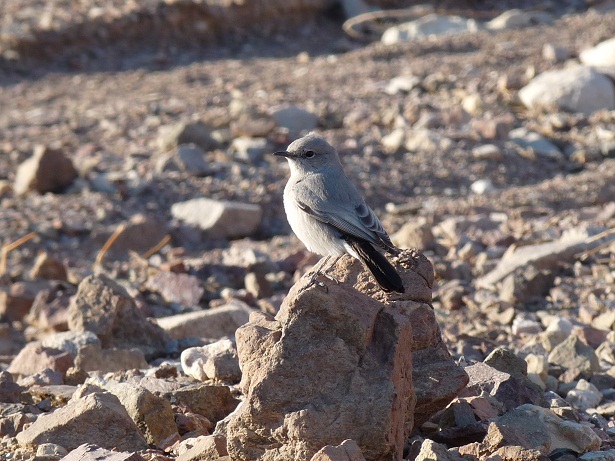
I then headed back to Eilat along the drainage canal, seeing plenty of immature gulls I couldn't identify as well as Black Stork and Caspian Tern, before heading up into the hills and Wadi Shachamon. This wadi contains typical desert habitat right on the edge of town and used to be a regular wintering site for Pallid Scops Owl. There have been no reports so far this winter but Noam was confident they should be back already and told me how to look for them so I was pretty confident I would find one if it was there. It wasn't, of course, but I thoroughly enjoyed my first taste of desert birding in seven years, with White-crowned Black-Wheatear singing within sight of Eilat's last apartment blocks, Blackstart (above), one of my absolute favourites, everywhere, Palestine Sunbird, two Desert Larks feeding at my feet, and a pair of Scrub Warblers showing exceptionally well.

There was also a flowering bush covered in butterflies but, in my rush to check every acacia tree for the owl, I only took pictures of one species. It turns out to be an African species which is rapidly colonising the eastern Mediterranean and has the wonderful name of Pomegranate Playboy (Deudorix livia).

Eilat day 2 (part 1)
Having already been to Israel, and Eilat, 4 times, this holiday was more about relaxed birding and regularly working my temporary patch than chasing after the few highly localised and difficult species I've still not seen. So, after an early morning walk around Ofira Park with much the same birds as the previous day as well as a noticeable arrival of Chiffchaffs, I headed to the IBRCE, where I met with its director Noam Weiss. He was extremely helpful and gave me all sorts of tips and directions to find some lifers so that I decided to give some of them a go after all. I spent the rest of the morning around the reserve, which was rather quiet but nonetheless provided Little Green Bee-Eater, Graceful Prinia and one or two Marsh Sandpipers, and enjoyed watching a mixed flock of winter-plumaged Dunlin and Little Stints feeding right in front of one of the hides.


Thursday, 28 November 2019
Eilat day 1
Eilat is one of my favourite places in the world to go birding. Being at the junction of three continents, there is a wonderful mix of European, Arabian and African species, supplemented twice a year by the millions of migrants passing through on their way to or from their wintering grounds in Africa. As such, there is always a feeling of excitment to birding around Eilat, not quite knowing what could turn up next, together with a myriad of non-breeding plumages to keep even the most experienced birders on their toes. With just a week's holiday to take this year and only a short weekend in Dublin since I started my new job back in May, it didn't take me long to decide where to spend it once I found out about the ridiculously cheap flights Transavia are offering from Amsterdam to Eilat this winter.
When arriving into a new country, I always wonder what will be the first bird I encounter, and the new Ramon International Airport, located out in the desert, didn't disappoint as the very first birds I saw were a pair of Brown-necked Ravens playing with a stick. Once in Eilat, having spotted some Greater Flamingoes from the bus, I was pleased to find my room looked out over Ofira Park. This city park is perhaps my favourite place within Eilat as, during spring migration, it has been so full of migrants you are almost kicking the Wrynecks out of the way! This was the end of November, however, with migration seemingly over. Still, my first short walk around the park provided lots of wintering White Wagtails, a juvenile Masked Shrike, plenty of House Crows and a mixed flock of both House and Spanish Sparrows, not bad for my first twenty minutes or so.
I then headed towards the infamous North Beach and was amazed to see Tristram's Grackle at the marina. This used to be a truly desert species for which one had to travel all the way up to the Dead Sea in order to have a reasonable chance of seeing, but seems to have expanded its range and now hangs around the hotel balconies in downtown Eilat!

When arriving into a new country, I always wonder what will be the first bird I encounter, and the new Ramon International Airport, located out in the desert, didn't disappoint as the very first birds I saw were a pair of Brown-necked Ravens playing with a stick. Once in Eilat, having spotted some Greater Flamingoes from the bus, I was pleased to find my room looked out over Ofira Park. This city park is perhaps my favourite place within Eilat as, during spring migration, it has been so full of migrants you are almost kicking the Wrynecks out of the way! This was the end of November, however, with migration seemingly over. Still, my first short walk around the park provided lots of wintering White Wagtails, a juvenile Masked Shrike, plenty of House Crows and a mixed flock of both House and Spanish Sparrows, not bad for my first twenty minutes or so.
I then headed towards the infamous North Beach and was amazed to see Tristram's Grackle at the marina. This used to be a truly desert species for which one had to travel all the way up to the Dead Sea in order to have a reasonable chance of seeing, but seems to have expanded its range and now hangs around the hotel balconies in downtown Eilat!
The seafront gardens provided another desert species which seems to have moved into town, namely Rock Martin, while North Beach itself was quiet other than a single Common Sandpiper and lots of White-eyed Gulls coming in from Jordan to roost at dusk. Nevertheless, I was very happy with my first afternoon's birding and full of anticipation as to what the next few days would bring.
Subscribe to:
Posts (Atom)