Showing posts with label Alps. Show all posts

Thursday, 5 October 2023

More of Modane (part 3)

So, after two years and two aborted attempts, I finally made it back to the Vallon de l'Orgère at the start of August.  This time the bus was running and a friend from France even joined me for the first day's hike to the Lac de la Partie at 2500m altitude.


Unfortunately, it rained quite a lot while we were up around the lake so we saw no butterflies whatsoever but we did enjoy watching a flock (!) of around a dozen Alpine Accentors, and almost stepped on a White-winged Snowfinch.  The sun was out, however, for our climb up and once we got back down into the valley, so we still managed to see some butterflies, including lots of Damon Blues and my first Marbled, Mnestra's and Common Brassy Ringlets.


On the second day, I concentrated on the valley, adding a few more species and ending on this crazy puddle party at the stream we had walked down the previous day.  A single Common Brassy Ringlet was outnumbered by the many blues - I counted ten different species, including my first Glandon Blue.


By the end of the two days, I'd added 10 new species to my list, with another two photo's of the terribly difficult Pyrgus-skippers still pending identification.

Sunday, 24 September 2023

More of Modane (part 2)


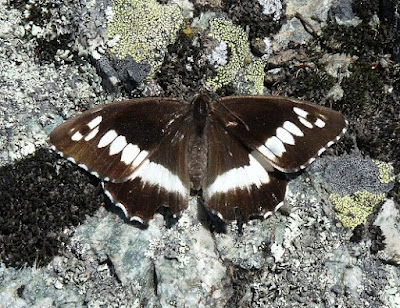
As mentioned in my previous post, the main reason I went back to Modane was for butterflies.  Two years ago, I'd given it a try and found it was a great place to see them, especially the picturesque Vallon de l'Orgère, at an altitude of 2000m.  I had hoped to go back last summer but my ankle injury forced me to cancel that trip so I had to wait until the end of June this year.  My plan was to take the once-a-day hiker's bus up to the valley but that didn't start running until July 1st, a week later, and there was no way I was going to attempt the nightmare, three-hour hike straight up from Modane again.  Rather than pay a ridiculous amount for a taxi to take me the 30km or so by road up to the refuge, I decided to stick to the hillside behind Modane and try to return again later in the summer for the higher altitude species.  Naturally, spending three days exploring the same area I'd done two years previously made finding any new species difficult and I only ended up with six lifers, three of which were seen during my Rock Partridge excursion further along the valley.  The biggest suprise of all, though, came on the first evening, when, tired from the day's hiking, I went for a short stroll along the river before having dinner, and stumbled upon this extremely tatty Camberwell Beauty sunning itself on the path!

Thursday, 31 August 2023

More of Modane (part 1)

I'm well behind with my blogging but, at the end of June, I finally made it back to Modane, which I visited two years ago.  This time, I'd given myself four full days there, primarily for butterfles (more of which later), but I also booked a day with a local, mountain guide to try and find Rock Partridge, one of the few European species I'd not yet seen.  He admitted he'd never gone specifically looking for Rock Partridges before, most of his clients wanting to see marmots, ibex and Black Grouse, but he certainly knew where to look.  After a steep hike up to the edge of the Vanoise national park, he'd only just said that we were reaching the likely area to see Rock Partridge when he spotted a distant one on a boulder overlooking the valley.


I really hadn't rated our chances knowing how shy they are and having failed to find them elsewhere in the Alps, although admittedly where they are even rarer, so I was thrilled by our immediate success but the above silhouette was pretty much all I saw of the first bird as it then took off and disappeared behind the outcrop.  Another two very distant views of perched birds followed but I could hardly make out any colours at all, although we could hear several more calling from the hillside above us.  We thus decided to have a picnic below some rocks where my guide thought they might be and, sure enough, one then started calling.


The calls sounded ever so close and, scanning the area, we soon realised why since I located the male at the base of the arch in the centre of the above picture, using the rock formation to amplify and resonate his call.  Here is another, strongly zoomed-in shot from the same position, with the bird perched in the shadow just to the left of the pine tree.


Thankfully, my guide's assistant had brought a hand-held telescope so I finally got to see all the markings and the male was even joined by a feeding female for a while.  Mission accomplished; my one and only new (bird) species of the year thus far. 
Many thanks to Oliver Trompette, whose magnificent wildlife photography can be seen here.

Monday, 11 July 2022

Topsy-turvy world

I'm still struggling to get around but, thankfully, one of the guides at Cristalino Jungle Lodge is keeping me busy whilst stuck at home by regularly sending photo's for me to identify or just admire. 
Now, everyone knows that butterflies fly during the day and moths at night, and their respective Dutch names of dagvlinder and nachtvlinder even incorporate that fact.  Most people also know, however, that some moths are active during the day, such as the Hummingbird Hawk-moth, which has resulted in several laymen coming up to me and claiming they have seen a hummingbird in Europe, the burnets, or this Nine-spotted Moth (Amata phegea) from the Alps.


Fairly recently, though, a group of moths, the Hedylidae, were found to be genetically closer to the butterflies than other moth families and thus reclassified as nocturnal butterflies.  There is even one species of Hedylidae, Macrosoma tipulata, which is more active during the day, making it the exception to the exception to the rule, or a day-flying nocturnal butterfly!  Try to get your head around that one, or just admire the latest addition to the Cristalino butterfly list, which has now officially passed 1000 confirmed species thanks to these nocturnal butterflies.

Macrosoma sp by Sidnei Dantas

Friday, 24 December 2021

Alpine advent Day 24

And finally, Great Banded Grayling/Kanetisa circe was quite common but I had to place a dead one on a rock with its wings open in order to get a picture of the upperside.


The two new species I saw but didn't manage to photograph were Clouded Apollo and Moorland Clouded Yellow, so here's hoping I can get back to Modane next summer for those and more!  Happy holidays.

Thursday, 23 December 2021

Alpine advent Day 23

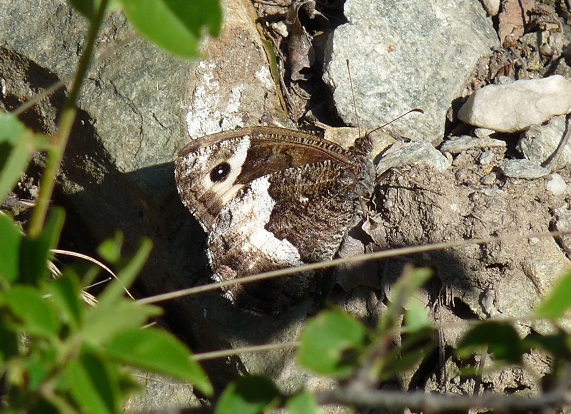
This, on the other hand, seems to be Swiss Grayling/Hipparchia genava.  It is slightly smaller, although that is only useful when seeing the two side-by-side, and tends to prefer more open, rocky habitats.  Notice how the brown-white border seems to be more of a diagonal line with a central brown triangle protruding into the white band.  Also, the brown on the forewing tapers to a much more elongated point below the ocellus than the previous species.

Wednesday, 22 December 2021

Alpine advent Day 22

The next species pair can only really be identified by studying their sexual organs under a microscope, although there are some consistent differences in the wing pattern which help point in the right direction.  This, therefore, is probably Woodland Grayling/Hipparchia fagi, based primarily on size, habitat and the fairly evenly curved border between the dark-brown and the whitish band on the hindwing.

Tuesday, 21 December 2021

Alpine advent Day 21

Great Sooty Satyrs/Satyrus ferula were everywhere but it took me a long time to get the hang of them due to their strong sexual dimorphism.  Here, first, is the underside of a male followed by the upperside of a female, the opposite views already having appeared in my trip write-up.

Monday, 20 December 2021

Alpine advent Day 20

The last, and largest, of the four, new species of erebia I manged to identify was Piedmont Ringlet/Erebia meolans, which I only saw around 1900m.

Sunday, 19 December 2021

Alpine advent Day 19

Lesser Mountain Ringlet/Erebia melampus is just as small and rather similar, except the orange band is less solid and it also has orange spots on the underwing.

Saturday, 18 December 2021

Alpine advent Day 18

Considerably smaller is the Mountain Ringlet/Erebia epiphron, here the subspecies aetheria, which has tiny ocelli and a plain underwing.

Friday, 17 December 2021

Alpine advent Day 17

The erebias are a truly alpine genus.  Only two species just about reach the very south and east of Belgium, where they are both scarce, whereas almost twenty species can be found in the area I visited.  They are all dark brown with varying amounts of orange and ocelli, with considerable subspecific and individual variation making their identification a nightmare.  The very first one I saw landed on my shoe and I only got a shot of the underside so I needed some expert help to id it as Large Ringlet/Erebia euryale.  I was happy, therefore, to later find another one with its wings open.

Thursday, 16 December 2021

Alpine advent Day 16

This is the only photo I took of what I think is Dusky Meadow Brown/Hyponephele lycaon, although I'm still waiting for my id to be confirmed.

Wednesday, 15 December 2021

Alpine advent Day 15

Northern Wall Brown/Lasiommata petropolitana is virtually identical to the more widespread Large Wall Brown except for a distinctive, dark brown line across the upper hindwing, visible in the second picture.

Tuesday, 14 December 2021

Alpine advent Day 14

Knapweed Fritillary/Melitaea phoebe was less numerous and I only managed to identify a couple of them.

Monday, 13 December 2021

Alpine advent Day 13

I saw ten species of fritillary in the Alps but only two of them were new for me.  Titania's Fritillary/Boloria titania seemed to be quite common around 1900m.

Sunday, 12 December 2021

Alpine advent Day 12

Of the six new species of blue I recorded, I was most pleased to find this Meleager's Blue/Meleageria daphnis, with its rather distinctive wing shape (females are even more irregular).

Saturday, 11 December 2021

Alpine advent Day 11

This one immediately struck me as being a different shade of blue to all the others and, despite getting just the one photo, I think it is probably Turquoise Blue/Plebicula dorylas.

Friday, 10 December 2021

Alpine advent Day 10

Geranium Argus/Eumedonia eumedon is one of several blues which aren't actually blue.  This is probably a female due to the orange lunules on the upper hindwing, posing together with day 3's Dusky Grizzled Skipper.

Thursday, 9 December 2021

Alpine advent Day 9

The Cranberry Blue/Vacciniina optilete picture already posted, could really have been anything since the distinguishing feature wasn't visible.  This blurry photo allowed me to make the id, however, since it clearly shows the single orange spot on the hindwing.