
Tuesday, 1 December 2015
BButterfly advent Day 1
As this was my first summer in Europe since 2012, I did quite a bit of Belgian butterflying, seeing five new species as a result. I thus decided to dedicate this year's online advent calendar to Belgian butterflies, with the aim of providing a mini photographic identification guide to some of Belgium's commonest and prettiest species. To start with, here is nice, late-summer image of a Map Butterfly and Gatekeeper feeding on thistles.


Monday, 9 November 2015
An eagle bogey
I have finally added White-tailed Sea-Eagle to my Belgian list (now at 303 species) thanks to a long-staying immature in the Dijle valley. It has been there since 25 October but this was my second attempt to try and see it. The first time, it flew off in a southerly direction before I arrived and everyone assumed it had moved on, only for it to return just ten minutes after I had left! This time, though, it was sitting, amazingly well camouflaged, at the edge of the reeds when I arrived and we were soon treated to it circling over the lake, scattering the assembled gulls, Cormorants, and waterfowl, including two Pintail drakes. A group of six Cormorants then entertained us by doing some formation fishing, and there were two Little Egrets plus three Great White Egrets present, one of the latter showing just how big they are by standing next to a Grey Heron.


A couple of Grey Herons migrating over Brussels last week were new for my balcony list, as was a single Fieldfare in a flock of Starlings.
Monday, 2 November 2015
Reuland wanderings

Yesterday, I did my annual, autumnal hike across the Reuland plateau, together with a visiting birder who wanted to see Nutcracker. It was a beautiful day as you can see above but much quieter birdwise than this time last year, with very few migrants around. Nevertheless, we managed to see both Short-toed and Eurasian Treecreepers well and got great looks at Marsh, Willow, Crested and Coal Tits, the latter of which we watched bathing in a puddle. There was no sign of any Nutcrackers anywhere so we arrived a little disheartened into Stavelot, where a big group of at least 150 Fieldfares were pretty much the only birds we'd seen all afternoon. As we were waiting for the bus, however, I noticed a big line of Cranes in the distance which contained at least 650 birds. The same group was spotted almost an hour later, 65km to the south, meaning that they were flying at 60km per hour at least, although it is unlikely they were flying in a straight line. No sooner had they disappeared, I noticed what I thought was going to be our umpteenth Jay of the day flying over the road but, at first glance, it seemed rather dark. It then circled around, revealing the shorter tail, broader wings and distinctive bill shape of a Nutcracker, giving my visitor a brief but convincing view before it, too, flew off out of sight. Phew!
Monday, 26 October 2015
Wot, no nuts?
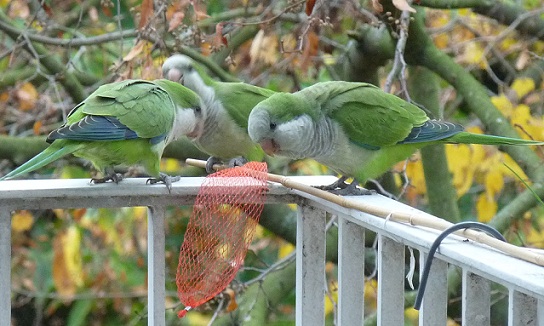
One evening last week, I hung out some nuts on my balcony, fully expecting it would take the local birds a few days to discover them. By 10am the next morning, however, there was already a Great Tit feeding away and, by the weekend, the Monk Parakeets had emptied the bag entirely. Only two other species were quick enough to react before the parakeets invaded, namely Blue Tit and Jay (see below).
This morning, I spent an hour and a quarter watching the migration from my balcony with the following results; Skylark 8, Cormorant 4, Brambling 1, Redwing 78, Song Thrush 1, White Wagtail 1, Rook 2 and Jackdaw 6. Best of all though was a huge flock of Woodpigeons, I reckon somewhere between 400 and 500, with at least one Stock Dove tagging along. I then went for a walk in the Dijle valley south of Leuven this afternoon, and saw another 210 Woodpigeons go over, but the sheer scale of today's migration is put into context by one observer's count of 44,847 in the south of Belgium! My balcony list now stands at 36 species, other additions to those mentioned above being fly-by Egyptian Geese, Greenfinch, Black-headed Gull, plus a Great Spotted Woodpecker seen from the comfort of my living room.

Tuesday, 20 October 2015
Autumn arrivals
I had hoped to be writing about my first Olive-backed Pipit but, having spent all weekend in the same spot at the Belgian coast while I was busy working, it was no longer around on my day off yesterday. Still, as I got out of the coastal tram in Heist, the bushes were alive with Goldcrests, Coal Tits and Chiffchaffs. Redwings were absolutely everywhere, with at least twenty of them foraging together in one grassy field. There were also good numbers of Song Thrushes and Blackbirds, especially first-winter birds, around, plus various small flocks of Siskin, Greenfinch and Goldfinch, with a few Bramblings passing over. Some Long-tailed Tits were in a mixed feeding flock containing at least two Firecrests and I wasted a good half hour trying in vain to get a photograph of one, but they just wouldn't stop moving. Now, if Long-tailed Tits are too active to photograph, then you might as well forget about the 'crests but, when a Goldcrest started gleaning insects right in front of me, I just had to give it a try. Sure enough, the first twenty or so pictures were blurry or only showed some random body part. My preserverance eventually paid off, though, with this unbelievably lucky shot of the whole bird, including its gold crest!


Wednesday, 14 October 2015
Balcony birding
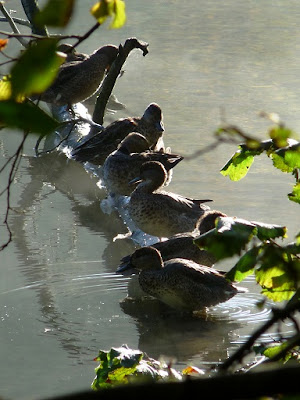
I've only managed to add two new species (Rook and Long-tailed Tit) to my balcony list since my last post, although the latter was from within the warmth of my living room as they were feeding together with three Coal Tits in the tree directly opposite which almost touches my balcony. Identifying things from my balcony is quite difficult as it faces west, meaning most of the migrating birds come from behind my building and aren't visible until they have passed over me and are heading away. I already have possible Snipe, Goshawk and Peregrine, therefore, as well as numerous passerines, on my unidentified list, together with various heard-only species. Even balcony birding is not pleasant any more now that the weather has turned cold and grey unusually early, with the first snow showers already noted in the Ardennes. My only trips out so far this month have been to my patch in the south-east of Brussels, where I saw a migrating group of around 140 White-fronted Geese with a single Shoveler trying to keep up. Firecrests have again been very conspicuous, and I even got to see one male flaring his crest, which does not happen very often. My visit there last Friday produced 49 species; nothing really unusual but it was nice to see 7 female Teal lined up on a submerged log. One doesn't usually give these ducks a second glance as, apart from the green speculum, they appear very drab. It's only when you get up close, you realise how wonderfully and intricately vermiculated their plumage is.


Wednesday, 7 October 2015
New horizons


Subscribe to:
Posts (Atom)