Friday, 30 June 2023

Baby baby


A couple of weeks ago, I twitched this pair of Bee-Eaters which seem to be breeding in the province of Antwerpen.  This is only the third time I've seen this species in Belgium, averaging out at once every ten years!


Just as exciting though, was this Grey Wagtail nest I discovered when an adult was walking around calling just ahead of me and I noticed begging calls coming from a crack in the concrete pillar right next to the path.


The ever so cute nestlings looked like they were ready to fledge and kept clambering around on the edge of their nest every time mum or dad returned with a beakful of insects.

Sunday, 18 June 2023

Moorlinse grebery


Last weekend saw me back in Berlin for another city trip and a much anticipated third visit to what has quickly become one of my favourite places to birdwatch.  My two previous visits in October and May produced a whole range of species from Tundra Bean Geese and Cranes to breeding Red-necked Grebes, Marsh Harrier and Nightingales, so I was eager to see what else might be there in June.  Reed Buntings were particularly confiding with this male singing and preening right next to the observation platform.


New species for my budding Moorlinse Buch list included a singing Icterine Warbler it took me a good 15 minutes to locate, Honey Buzzard and two heard-only Great Reed Warblers but, once again, the grebes were the stars of the show.  I saw several pairs of Red-necked Grebes feeding young but these were easily outnumbered by Great Crested Grebes and their offspring, with quite a few Little Grebes also present.  I don't think I've ever seen such a concentration of young/breeding grebes in such a small area.  I decided to take my time and also explore the nearby Karower Teiche, where singing Golden Orioles, two Lesser Spotted Woodpeckers and a family of Redstarts completed the day's list, which totalled an amazing 70 species. 
I can't wait to go back again!

Saturday, 3 June 2023

Back to butterflying

 
Having missed last year's butterfly season due to my ankle injury, I was eager to do some proper butterflying this year and finally got to do my first real butterfly outing in almost two years earlier this week.  I visited my favourite butterfly reserve near Couvin but it seemed very quiet at first, with an unexpected Kingfisher and a Black Kite making it look as if the birds were going to have the upperhand.  This Black-veined White was the first butterfly I saw and, together with Small Heath, the only ones present in good numbers but there were also quite a few Adonis Blues, which only have a few Belgian colonies, around.


By the end of the day, though, I'd somehow managed to identify 20 species, including other rare species restricted to this area such as Scarce Swallowtail and Large Wall Brown, with two Red-backed Shrikes as an additional bird bonus.

Saturday, 27 May 2023

Stilt tsunami


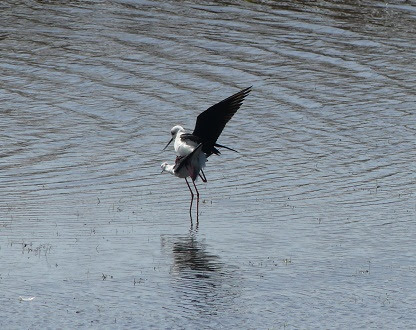
Earlier this month, before my UK trip in fact, I went to visit some of the huge numbers of Black-winged Stilts that have turned up in Belgium, as well as the rest of north-western Europe, this spring.  It would seem a drought in Spain has dried up their usual breeding grounds so they moved north in search of wetter areas and, after the exceptionally wet spring we have had, found plenty of flooded fields and other marshy areas to their liking.  We would normally get around a dozen or so overshoots each spring but, at the start of May, it was more like 200 or more individuals.  They wasted no time and started breeding immediately; this female being one of at least three birds I saw on nests.


I counted at least 31 of them, which is more than the total I have seen in all my years in Belgium, whereas up to 50 have been reported from this one site near Bruges and the first chicks have already hatched.  The supporting cast included a Greenshank, several Wood Sandpiper, 4 Ruff still in winter plumage and this splendid pair of Black-necked Grebes in full breeding plumage.

Wednesday, 17 May 2023

Croeso i Gymru


I did a whirlwind tour of North Wales over the weekend, visiting the flagship reserves of South Stack and Cemlyn lagoon on Anglesey, as well as RSPB Conwy.  As you can see, it was a beautiful day, the best day of the week by far.  At South Stack, we saw the resident Choughs, Fulmars, Guillemots, Razorbills and four Puffins (out of an estimated eight breeding pairs!).  Cemlyn was, unusually, full of staging Arctic Terns easily outnumbering the Common Terns, with the Sandwich Terns at various staging of breeding including some on nests and others mating.  Other species we saw included a single Black Guillemot in Holyhead harbour, at least three Red Kites (which are scarce in this part of Wales) and a pair of Mediterranean Gulls breeding amongst the terns at Cemlyn, with the day list totalling 72 species.  Many thanks to Chris Tynan, the leader of RSPB Liverpool Local Group for a lovely day out.

Cemlyn tern colony

Monday, 1 May 2023

Booted bonus

On Saturday evening, 29th April, I was just thinking that the Swifts should be back the following day and sat down looking out over my balcony, only for my first Swift of the year to appear a few minutes later, hawking insects above the park!
Yesterday, I guided a group around my old patch of Mechels Broek, near Mechelen, and, recognising their distinctive screaming calls, spotted a migrating flock of 30 Swifts high in the sky.  It was a beautiful morning, with a singing Nightingale a couple of people managed to see briefly, a pair of perched Kingfishers and lots of recently-arrived Whitethroats entertaning us with their display-flights.
Having enjoyed a Kestrel divebombing a Buzzard, with several White Storks circling around, I was looking at another Buzzard when a second, much higher raptor flew into my field of view.  As it circled, I got to see the distinctive white-black underwing pattern of a stork, and really had to look hard to make sure there wasn't a long neck and beak attached but no, it had a very small head which hardly protruded from the body.  It was only then I realised we were looking at a Booted Eagle, my first in Belgium, just before it glided off high to the south-east.

Not yesterday's bird, this was taken in Israel.

Tuesday, 18 April 2023

Catching up

At the end of March, I had a lovely walk in the ForĂȘt de Fontainebleau, south of Paris, hearing several singing Cuckoos and finding a single Bonelli's Warbler.  This is the closest this species breeds to Brussels but I wasn't sure they would be back so early.  Three Black Woodpeckers showed unusually well in an aerial display flight and I was very pleased with myself for locating a male Lesser Spotted Woodpecker by its tapping. 
The first half of April was very wet, especially on my days off, although a male Common Redstart which appeared next to my balcony on my birthday, was not only a nice birthday present but the 76th species for my apartment/balcony list.  Apart from a couple of brief walks in Brussels, during which I found a singing Willow Warbler and also saw my first Swallows and House Martins of the year, I'd not done any proper birding trips this month, so I spent the past couple of days at the coast.  I had planned to do a migration count this morning but the strong north-easterly wind meant there was little migration and made standing on the exposed sea-dyke unbearable so I only lasted an hour.  During that short time, though, I still managed to count almost 400 birds of 20 species going past, three-quarters of them being Linnets and Meadow Pipits in roughly equal numbers.  Over the sea, I saw small groups of Shelduck, Avocet and Knot, and five Spoonbills also flew over once I was back down in the polders.  Here, Sand Martins joined the migrating Swallows, Meadow Pipits and Linnets, with lots of Whimbrel around, a few Blue-headed Wagtails, and plenty of Sedge Warblers busy singing.