Thursday, 5 December 2019
Ode-vent Day 5
The bluetails are probably the best known of our damselflies with their distinctive 'tail-lights'. The bicoloured pterostigma also helps tell them apart from other bluets. Only two species occur in Belgium and most of Europe, the blue being closer to the tail tip on Scarce Bluetail. This Blue-tailed Damselfly (Ischnura elegans) is one of our commonest and most abundant species and easily found wherever there is some standing water.
Wednesday, 4 December 2019
Eilat day 4
Spurred on by my success of the previous day, I took the early (06h30) bus to Uvda valley, an extremely remote and extensive wadi which potentially held at least five more lifers for me. Before arriving in Eilat, I had no idea this area could even be reached by public transport but Noam's excellent directions convinced me to give it a go, especially since I was told there were lots of Temminck's Larks around. I was thus hopeful of finding at least one new species but, once there, the plain seemed totally devoid of life, as is often the case in the desert. The first bird I saw was a Hoopoe Lark, a highly sought-after species I'd only seen once before, although it took me quite a while to work out what it was in the early morning light. I then found a swath of green stretching across the valley which was alive with wagtails, Stonechats, Desert Larks and Mourning Wheatears. Here, I spotted a small, black wheatear perched atop a bush and immediately noticed a more compact profile, more rounded head and shorter bill compared to the more elongated, almost Blue Rock Thrush-like profile of the many immature White-crowned Black Wheatears I'd seen over the past two days. It soon dropped down from the bush and flashed white at the bases of the primaries, leaving me in doubt that I was watching a Basalt Wheatear! This is an extremely rare and little-known taxon with an estimated population of just a few hundred pairs restricted to the basalt desert of southern Syria and northern Jordan, a very small percentage of which (probably less than 10 individuals) overwinters in a few scattered and isolated localities in southern Israel. It is currently considered a subspecies of Mourning Wheatear but may well be raised to species status soon, so was a semi-lifer. As exciting as it was, I still hadn't found any of my target species and it was already very hot out on the exposed plain so I pressed on, conscious of the need to get to somewhere with shade as the temperature rapidly approached 30°C. Despite the reports, however, the only larks I could find were Desert and lots of Crested, so I reluctantly headed back to Eilat, where I could only muster the energy for a short visit to North Beach in the late afternoon, finally managing to identify some of the gulls as Heuglin's. This is another taxon in limbo since it is either a distinct species or a Siberian subspecies of Lesser Black-backed Gull, depending on which authority one follows.
A desert in the desert; female Desert Wheatear which took me far too long to identify!
Labels:
Eilat
Ode-vent Day 4
Willow Emerald Damselfly (Chalcolestes viridis), is by far the commonest spreadwing and easily recognised by its cream-coloured pterostigma. It prefers ponds surrounded by trees and hundreds of them can be found during late summer in places such as Rouge-CloƮtre/Roodklooster and the Sonian Forest.
Tuesday, 3 December 2019
Ode-vent Day 3
The Lestes, or spreadwings, are, as their name suggests, the exception among the damselflies since they perch with their wings open. Not particularly common or easy to see, some of the five species occurring in Belgium are difficult to tell apart, with the amount and shape of the blue markings on males as well as the shape of the appendages at the tip of the abdomen being diagnostic. Another very important feature for all odonata is the pterostigma, the coloured patch along the leading edge of the wings, which is dark in this Emerald Damselfly or Common Spreadwing (Lestes sponsa).
Monday, 2 December 2019
Eilat day 3
For my second full day, I headed up the Arava valley to Kibbutz Samar, which, I was told, was the place to find Black Scrub-Robin. Sure enough, as soon as I got to the horse enclosure at the far end of the kibbutz, a beautiful Black Scrub-Robin perched out in the open before I'd even had a chance to get my camera out of my bag! I didn't manage any decent pictures, therefore, even though I saw it two more times over the next hour or so but was very happy with my first, and probably most wanted, lifer of the trip. Little Green Bee-Eaters (above) were feeding along the perimeter fence and I also photographed this butterfly which turned out to be a Desert White, another new species for me.
I then crossed the road to visit the kibbutz's sewage ponds, which held a Temminck's Stint and at least three Bluethroat, with a couple of Siberian Stonechats, a Hooded Wheatear and this Southern Grey Shrike of the local, aucheri subspecies along the way.
After that, I headed back into Eilat and returned to Wadi Shachamon to try and photograph some more butterflies since I didn't really have much time the previous day. The birds were pretty much the same as the day before and I only managed to get pictures of one new butterfly, this African Babul Blue.
Labels:
Eilat
Ode-vent Day 2
Beautiful Demoiselle (Calopteryx virgo) is the only other Calopteryx found in Belgium and most common in Wallonia, although a few individuals were found in Brussels this year, possibly indicating a northwards range expansion. Males are told from the Banded Demoiselle by their solid black wings, while the wings of females are brownish.
Sunday, 1 December 2019
Ode-vent Day 1
I'ts time for another online advent calendar! Since I didn't go to the Amazon this year, and the 2015 edition featured Belgian butterflies, I decided to focus on Belgian odonata this year. Odonata, or odes, as they are sometimes referred to, is the family comprising damselflies and dragonflies. Many birders turn to butterflies during the summer months, which tend to be quieter for birds, yet are daunted by the thought of trying to identify the odonata due to the many similar-looking species. With a bit of patience, however, knowing where to look for the distinguishing features, and a decent photo, one can identify most of the species which are likely to be encountered in Western Europe.
First of all, which is which? Damselflies tend to hold their wings closed when at rest (although there are exceptions) and are generally smaller and dainter than the more robust dragonflies, which almost always rest with their wings outstretched.
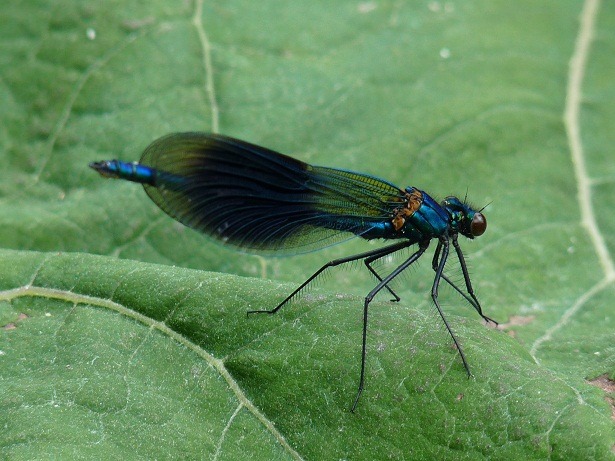
Calopteryx splendens, or Banded Demoiselle, is common throughout Belgium, including Brussels, where it can be most easily seen in Woluwe Park. Unlike most other damselflies, this family prefers running water and so is mainly found along streams. It gets its name from the distinctive, dark band on the wings which is only present in males, the females having plain, greenish-tinted wings.
Subscribe to:
Posts (Atom)